Rugged Devices
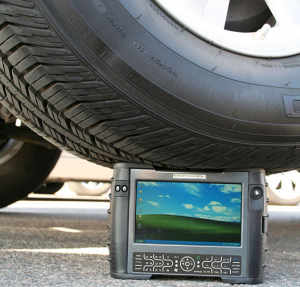
In the past, an important limitation of devices such as laptops, tablet, PDA e smartphone was the fragility that made their use inappropriate in dangerous work environments.
This serious problem was solved in the early 1990s with the introduction of the Rugged devices.
These are designed and manufactured specifically to operate in the most extreme and dangerous situations and are therefore ideal for use in public safety, hazardous transport, earthmoving, large-scale distribution and the military, and in all situations where one cannot pay much attention to the health of one’s equipment.
All rugged devices possess a number of common characteristics:
- Use of selected components to withstand much higher and much lower operating temperatures than those at which normal household devices usually work;
- Use of a ‘watertight’ keyboard so that dust and liquids cannot penetrate inside the device;
- Use of screens made of special materials so that they are resistant to shocks and scratches and allow trouble-free reading even when reflecting sunlight.
The Standards
To indicate the ability of devices to withstand dangerous external agents, there are a number of standards and certifications. Among these, a very important certification is the IP certification.
The IP protection class (International Protection) is a series of letters and digits (IP XX) that indicate how well a device can withstand certain external agents, and to make this classification easy, a series of codes have been used to denote this type of protection.
These codes consist of a fixed IP part plus two digits that vary according to the level of protection.
-
IP X-: the first digit indicates the level of protection of critical or hazardous parts from contact with objects.
Of this subgroup, there are 7 levels of protection, which are:
- IP0-: no protection (all external solid bodies can gain access);
- IP1-: body protected against solid bodies larger than 50 mm;
- IP2-: body protected against solid bodies larger than 12 mm;
- IP3-: casing protected against solid bodies larger than 2.5 mm;
- IP4-: body protected against solid bodies larger than 1 mm;
- IP5-: partially dust-protected housing;
- IP6-: body totally protected against dust.
-
IP -X: the second digit, on the other hand, indicates the level of protection of the entire device against the access of liquids into its internal body. Of this subgroup, there are 8 levels of protection, which are:
- IP-0: no protection (all liquids can access internal components);
- IP-1: shell protected against vertically falling water drops;
- IP-2: shell protected against falling water drops a maximum angle of 15°;
- IP-3: rain-protected shell;
- IP-4: shell protected against direct water spray;
- IP-5: shell protected against direct water jets;
- IP-6: wave-protected shell;
- IP-7: shell protected against temporary immersion;
- IP-8: shell protected against continuous immersion.
Other standards that are used for rugged devices are:
MIL-STD-810 G: is a military standard used as a reference in the commercial laptop industry that establishes a series of tests to determine the suitability of equipment for military operations. These tests include environmental conditions such as:
- Low pressure for the altitude test;
- Exposure to high and low temperatures, plus thermal shock, rain, humidity, fungus, salt spray for rust proofing, sand and dust;
- Exposure to explosive atmospheres;
- Resistance to acceleration, shock and vibration during transport;
ATEX: (ATmosfere EXplosibles) è a standard defining the possibility of using a device in potentially explosive environments. A potentially explosive atmosphere consists of air mixtures of gases, vapours, mists or dusts, which can ignite under certain operating conditions.
Equipment and protective systems that comply with the ATEX standard must fulfil certain requirements so as not to create ignition sources. These are:
- Sparks, electric arcs, electrostatic and atmospheric discharges;
- Electromagnetic waves;
- Flames;
- High surface temperatures;
- Acoustic energy emissions;
- Radiations;
- Adiabatic compressions and shock waves;
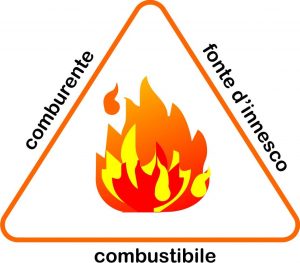
This can be represented graphically by means of the explosion triangle, where its sides indicate the three conditions necessary for an explosive reaction to occur.
Devices that comply with the ATEX standard find application in a variety of sectors including the oil, mining, chemical and food industries.
Classification of explosion hazard areas
-
The ATEX standard uses a classification of explosion hazardous areas derived from Directive 99/92/EC. This provides for six types of zones:
-
li>Zone 0: It is an area in which an explosive atmosphere consisting of a mixture of air and hazardous substances in the form of gas, vapour or mist is present for a continuous time, for long periods or frequently;
- Zone 1: It is an area where an explosive atmosphere consisting of a mixture of air and hazardous substances in the form of gases, vapours or mists is likely to be created during normal activities;
- Zone 2: It is an area in which an explosive atmosphere formed by a mixture of air and hazardous substances in the form of gas, vapour or mist is unlikely to form during normal activities, but if it does, it will persist for only a short time;
- Zone 20: It is an area in which an explosive atmosphere in the form of a cloud of combustible dust is present continuously or for long periods;
- Zone 21: It is an area where an explosive atmosphere in the form of a combustible dust cloud is created during normal activities from time to time;
- Zone 22: It is an area where an explosive atmosphere in the form of a combustible dust cloud is unlikely to form during normal activities, but if it does, it will only persist for a short period.