RFID technology
The ability to access key information in a company’s production process in real time is an opportunity to improve the quality levels of the final product.
The family of technologies that enable the automatic acquisition of identification data of objects and persons is called Auto-ID Technology (automatic identification technology) and among these, the use of RFID tags is becoming increasingly popular.
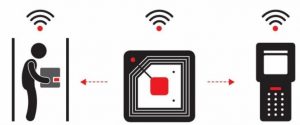
With the name RFID (Radio-Frequency IDentification) means that technology based on the ability to remotely store and access data using electronic devices called tags that are able to respond by communicating the information they contain when ‘interrogated’.
Specifically, such a system consists of three basic elements:
- A data storage device (tag or Trasponder);
- A read/write device (Reader);
- A system for data management and transfer (Tablet, Smartphone, etc..);
Applications
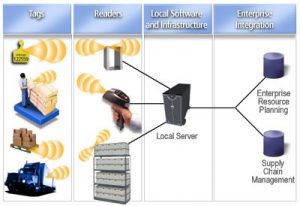
Thanks to the wide variety of technical features that industry hardware makes available, this technology can be used in a wide range of applications such as:
- Plant and machinery maintenance;
- Tracking files, books and documents;
- Anti-theft;
- Warehouse logistics and transport;
- Parking control;
- Electronic Ticketing;
- Passport;
- Identification of domestic and farm animals
RFID tags
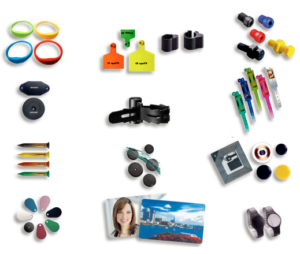
Also called an RFID transponder, it is the main element of the whole system as it allows data to be read and written on it. There are a large number of tags that vary in shape, size, material of construction, and operating frequency, but all of them can be grouped into three large families: Active, Passive and Semi-Passive or Semi-Active.
Active: This category includes all those tags that draw energy from their own power supply to operate, usually consisting of a long-life battery. This type of tag has the highest operating distance of all the others, reaching distances of up to 500 m; they may contain one or more antennas to send and receive data on different frequencies; they may also contain sensors to read in real time certain parameters of the devices on which they are applied such as pressure, temperature and heat.
Passives: This category includes all those tags that do not have their own energy source but derive it from the electromagnetic field generated by the reader/writer. As the reader passes through, the radio frequency activates the microchip inside the tag providing the energy needed to operate. This energy in the reading phase will be reused to respond to the reader by transmitting a signal with all the information stored inside; in the writing phase, on the other hand, it will save the data sent by the reader. This type of tag is composed of a microchip and a single antenna used for both reception and transmission.
Passive tags, depending on the frequency band they use to communicate and the electromagnetic phenomenon, can be subdivided into Near-Field RFID and Far-Field RFID.
Near-Field RFID: exploit the physical principle ofmagnetic induction Faraday’s principle in which the coil in the passive tag when passed through by a magnetic field (which in this case is generated by the reader/writer) generates an induced alternating potential difference which if suitably rectified can power the tag. This principle is used for frequency classes such as LF and HF.
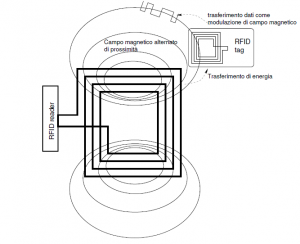
Far-Field RFID: in this case, we exploit the principle of capture of electromagnetic waves which are produced through a dipolar antenna contained in the reader. In contrast to the previous case, inside this type of tag we no longer find a coil, but another dipolar antenna that when excited by the reader produces an alternating potential difference that when suitably rectified allows the tags to be powered. The tags that exploit this physical principle are those that belong to the class of UHF.
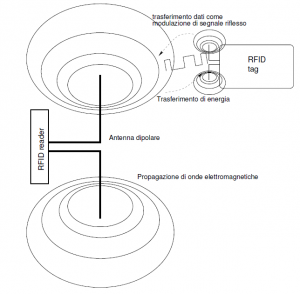
Semi-Passive: This type of tag has a battery that is only used to power the microchip or auxiliary equipment such as sensors but not to power a transmitter. When transmitting, they behave like a passive tag and for this reason are called semi-passive.
Semi-Active: this type of tag has a battery that powers the chip and the transmitter, but unlike active tags, the transmitter is deactivated to save energy and is only activated via a receiver using passive tag technology when a reader/writer makes a query. This variant of active tags due to the introduction of energy saving in the absence of interrogations can operate for very long times.
Frequency Classes
In addition to the type of power supply, RFID tags can be subdivided according to the frequency of the signals used in communication. There are several classes of frequencies, some of which are also regulated by ISO standards and have well-defined operating bands. The main classes are:
- Tag LF 125-135 KHz: also called Low Frequencies class, is a class valid worldwide; we find both passive and active tags, they have a limited reading distance (almost contact) and are used for burglar alarms, keys, presence and access control, tracking of pets and livestock, etc.
- Tag HF 13,56 MHz: also called High Frequencies class, is standardised by the ISO 14443 and ISO 15693 standards; it is used worldwide; we find both passive and active tags, with reduced reading distance (up to 1.20 m) and are used for books, pallets, access control, clothing etc.
- Tag UHF 868-915 MHz: also known as the Ultra High Frequencies media class is normalised by the EPC reference standards; we find both passive and active tags; it is a class valid worldwide even though the maximum power and frequency bands meet limits defined by the authorities of individual countries; tags in this class have a greater reading distance and are mainly used for active transponders in access control, vehicles, etc.
Other attendance classes are:
- UHF 433 MHz: Ultra High Frequencies low class; only valid in Europe and only for active tags;
- UHF 2,4 GHz: Ultra High Frequencies class; it is valid worldwide; it is mainly used for active tags, although passive tags exist;
- SHF 5,8 GHz: Super High Frequencies class; only for active tags and an example is the active tag ‘Telepass’;
- UWB 3.1-10.6 GHz: Ultra Wide Band class for active tags only.
Methods of use
RFID tags can work in two different modes:
- Read-Only: this is the mode that allows RFID technology to be used as if it were a barcode system, allowing only the ID on the tag to be read. In this mode we can exploit some of the advantages of RFID such as: reliability of reading; elimination of the need to see the tag in fact the radio tags can be contained inside the products; ability to work in contaminated and dirty environments;
- Read/Write: is the mode that allows not only a reading of the information but also its update on the chip. In this case, the tags are equipped with non-volatile memories of a few KB and can contain very detailed information about the object with which they are associated. In this way, the tag becomes an identification system that can also keep track of the history of a product right from the processing stage and can then be used interactively throughout the supply chain up to retail distribution and in some cases up to the consumer.
RFID Readers
The reader is, together with the tag, one of the basic elements for the functioning of the RFID system, and its choice is strongly linked to the type of application and the type of tags used; in fact, in order for the whole system to work properly, the reader/writer and the tags must be compatible in two fundamental aspects:
1) Type of Tag used (Active; Passive Near-Field; Passive Far-Field);
2) Tag frequency band (LF; HF; UHF)
Once Tag compatibility has been ensured, we can focus on the specific application of the system, going over:
- Shapes;
- Dimensions;
- Type of connection to the data management and transfer system (USB; Wi-Fi; Bluetooth);
- Portability of the player (Fixed; Portable);
- Type of reader (Rugged; Non-Rugged);
The latter points allow us greater flexibility in our choice than points 1 and 2, as we can find different characteristics of the same type of reader.